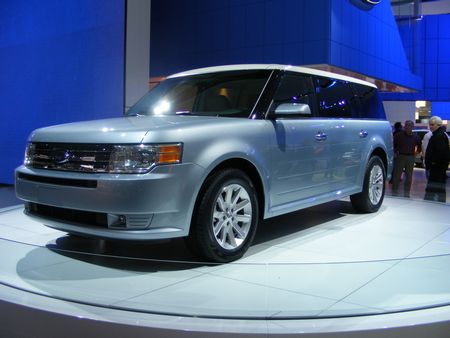
Ford Flex 2010
Introducing a new engine a couple years after a vehicle goes on sale isn't all that unusual. But, only one year after the Ford Flex first came out, there are several updates and upgrades for the 2010 model that make this nearly the equivalent of a mid-cycle refresh -- and this was a strong vehicle to begin with, not one already begging for improvements.
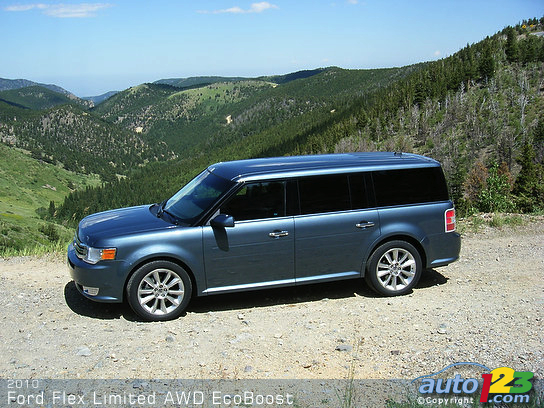
The big news is that there are now two engine options: the 262-horse, 3.5-liter Duratec 35 V-6, last year's only source of power in the Flex, is now the base engine. (Those who buy the SE or front-drive SEL or Limited get the Duratec.) As far as base engines go, this one's no slouch, getting the Flex to 60 mph in 8.5 seconds. Optional motivation is now provided by a 355-horsepower, 3.5-liter EcoBoost twin-turbo direct-injection V-6 (essentially the same configuration that's made its way into the Lincoln MKS and MKT). It also offers 350 pound-feet of torque at an impressive 1500 rpm, with a fairly flat torque curve. Ford gave an "about" 7.0-second 0-to-60-mph acceleration time for the Flex with EcoBoost. Shows what 93 extra horses will do.
This engine serves as the premium option, available only with all-wheel drive and it's an option only in the SEL or Limited. This means someone who wants a front-drive Flex can get one for as little as $29,270, but the least expensive Flex with EcoBoost is an AWD SEL, costing $36,890. The EcoBoost sits in the engine lineup where an optional V-8 would've been -- except unlike stepping up to the added power of a V-8 from, say, a V-6, there is no fuel-economy penalty, and it'll run on regular gas. Whether Flex buyers choose the Duratec or EcoBoost, AWD Flexes get 16 mpg city and 22 on the highway. (Front-drive models get 17/24 mpg.)
2010 Ford Flex Ecoboost Rear Three Quarter
Click to view Gallery
The Duratec's six-speed automatic remains unchanged, but the version backing the EcoBoost was strengthened to handle the increased torque. Addressing complaints of only having the choice of "D" or "L" with the Duratec, the EcoBoost's transmission comes with paddle shifters accessed through a manual mode on the floor-mounted shifter. Both six-speeds have identical gear ratios.
The new engine is surprisingly smooth and does a fantastic job of getting the crossover up to speed. The EcoBoost achieves this with a feeling of confidence and strength like a V-8, and with very little of the whine or lag you'd typically associate with a turbocharged engine. The paddle shifters came in handy on grades and when passing slower vehicles and is something we hope Flex owners will use. And 93 additional horses more than makes up for the EcoBoost's 4800-pound base curb weight.


The big news is that there are now two engine options: the 262-horse, 3.5-liter Duratec 35 V-6, last year's only source of power in the Flex, is now the base engine. (Those who buy the SE or front-drive SEL or Limited get the Duratec.) As far as base engines go, this one's no slouch, getting the Flex to 60 mph in 8.5 seconds. Optional motivation is now provided by a 355-horsepower, 3.5-liter EcoBoost twin-turbo direct-injection V-6 (essentially the same configuration that's made its way into the Lincoln MKS and MKT). It also offers 350 pound-feet of torque at an impressive 1500 rpm, with a fairly flat torque curve. Ford gave an "about" 7.0-second 0-to-60-mph acceleration time for the Flex with EcoBoost. Shows what 93 extra horses will do.
This engine serves as the premium option, available only with all-wheel drive and it's an option only in the SEL or Limited. This means someone who wants a front-drive Flex can get one for as little as $29,270, but the least expensive Flex with EcoBoost is an AWD SEL, costing $36,890. The EcoBoost sits in the engine lineup where an optional V-8 would've been -- except unlike stepping up to the added power of a V-8 from, say, a V-6, there is no fuel-economy penalty, and it'll run on regular gas. Whether Flex buyers choose the Duratec or EcoBoost, AWD Flexes get 16 mpg city and 22 on the highway. (Front-drive models get 17/24 mpg.)
2010 Ford Flex Ecoboost Rear Three Quarter
Click to view Gallery
The Duratec's six-speed automatic remains unchanged, but the version backing the EcoBoost was strengthened to handle the increased torque. Addressing complaints of only having the choice of "D" or "L" with the Duratec, the EcoBoost's transmission comes with paddle shifters accessed through a manual mode on the floor-mounted shifter. Both six-speeds have identical gear ratios.
The new engine is surprisingly smooth and does a fantastic job of getting the crossover up to speed. The EcoBoost achieves this with a feeling of confidence and strength like a V-8, and with very little of the whine or lag you'd typically associate with a turbocharged engine. The paddle shifters came in handy on grades and when passing slower vehicles and is something we hope Flex owners will use. And 93 additional horses more than makes up for the EcoBoost's 4800-pound base curb weight.
nissan gtr images
The rear end is characterize by the GT-R’s hallmark four-ring taillights, rear spoiler and large, integrated exhaust tips. The paint utilises a “double clear coat” and “anti-chipping” process and is hand-polished.
Interior Design
Like the exterior, the Nissan GT-R's interior is stylish but highly functional. The cabin is unique, sharing no major components or design features with any other Nissan model. Instruments are large, clear and simple, all directly in front of the driver for maximum legibility.
The circular analog instruments are ringed in chunky bezels and the tachometer is red-lined at 7000rpm and integrates a gearshift position display.
More unusual is a multi-function display, in the center of the dash, that not only gives a detailed log of the driving behavior - speed, g-force, fuel economy etc - but also gives details of the car's mechanical information (turbo boost, water and engine oil pressure, transmission oil, front/rear drive distribution etc) plus steering angles, braking and acceleration pressure, and also optimal gearshift mapping for best fuel economy.
The design of the multi-function display - which also includes the satellite navigation and audio controls - was done in conjunction with Polyphony Digital Inc, designer of the Gran Turismo video game series for Sony PlayStation. In the center of the dashboard, below the multi-function display, is a cluster angled towards the driver.
It contains switches for the air conditioning, audio and set-up switches, used to change the tuning of components including dampers, gear shift and VDC. The center console, which sweeps through the middle of the cabin, contains the red start button, the leather shift lever and parking brake, which aligns with the center armrest when off, functioning as an extended arm rest.
There is a full automatic gear change provision, useful in heavy traffic or when relaxing rather than sporty driving is desired. Seats are especially designed for the Nissan GT-R. They're heavily side bolstered for maximum lateral support and comfort and feature a wide range of adjustments.
The rear seats are more 'occasional' seats than full-size chairs.
The center console sweeps through the middle of the cabin, dividing left and right rear seats. Between the seats there is the provision for optional two BOSE sound system woofers.
The trunk is large (VDA: 315L), also thanks to the run-flat tires which obviate the need for a spare tire.
The seat has three color schemes: black, black with red highlight or gray.
Interior Design
Like the exterior, the Nissan GT-R's interior is stylish but highly functional. The cabin is unique, sharing no major components or design features with any other Nissan model. Instruments are large, clear and simple, all directly in front of the driver for maximum legibility.
The circular analog instruments are ringed in chunky bezels and the tachometer is red-lined at 7000rpm and integrates a gearshift position display.
More unusual is a multi-function display, in the center of the dash, that not only gives a detailed log of the driving behavior - speed, g-force, fuel economy etc - but also gives details of the car's mechanical information (turbo boost, water and engine oil pressure, transmission oil, front/rear drive distribution etc) plus steering angles, braking and acceleration pressure, and also optimal gearshift mapping for best fuel economy.
The design of the multi-function display - which also includes the satellite navigation and audio controls - was done in conjunction with Polyphony Digital Inc, designer of the Gran Turismo video game series for Sony PlayStation. In the center of the dashboard, below the multi-function display, is a cluster angled towards the driver.
It contains switches for the air conditioning, audio and set-up switches, used to change the tuning of components including dampers, gear shift and VDC. The center console, which sweeps through the middle of the cabin, contains the red start button, the leather shift lever and parking brake, which aligns with the center armrest when off, functioning as an extended arm rest.
There is a full automatic gear change provision, useful in heavy traffic or when relaxing rather than sporty driving is desired. Seats are especially designed for the Nissan GT-R. They're heavily side bolstered for maximum lateral support and comfort and feature a wide range of adjustments.
The rear seats are more 'occasional' seats than full-size chairs.
The center console sweeps through the middle of the cabin, dividing left and right rear seats. Between the seats there is the provision for optional two BOSE sound system woofers.
The trunk is large (VDA: 315L), also thanks to the run-flat tires which obviate the need for a spare tire.
The seat has three color schemes: black, black with red highlight or gray.
Subscribe to:
Comments (Atom)