Toyota GT-One Road Car
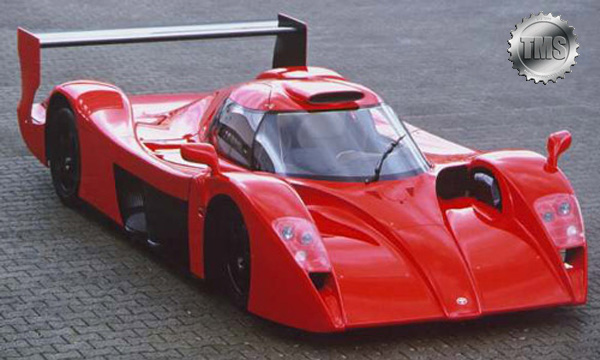
This car was built by Toyota Team Europe. It roars beautifully and can go pretty fast. I like the 1999 livery more than I do the 1998 livery. Both models could be found in Gran Turismo 2, including the road car. Here are as many pictures as I can use to describe this car.
The car has lovely character up front. A set of four small headlights on either side join together to provide the lighting for this car. Small vents under the headlights help feed some extra air into the car. Along the front, you note this F1-like design up front followed by two extra vents near the canopy of the car. With this being a right-hand drive car, the side mirror on the driver's right (from inside the car) is closer to the driver while the left side mirror is above the left-front tire. The areas around the front tires are opened up a bit from up front. Up top on the canopy is the big roof scoop feeding air into the Turbo V6 engine. Huge openings on the sides gives for better ability to cut through the wind. Up top is a wide and narrow hood scoop to feed air into that twin-turbo V6 engine. This car from the sides is gorgeous. Lots of swoopy lines and beautiful curves accentuate the car's design as it cuts through the air during a race. Big side ducts only added to the aggressive stance of this. The rear wing assembly is nothing overaggressive or flamboyant. It does, however, get the job done keeping the back end of this car weighed down. From the back, its elegance and charm is undeniable and graceful.
Mitsubishi Lancer Evo IV Cars
The Lancer platform was completely changed in 1996, and along with it the Evolution, which had become extremely popular throughout the world. The engine and transaxle was rotated 180° to better balance the weight and eliminate torque steer. There were two versions available, The RS and GSR.
The RS version was produced as a competition car with a limited-slip front differential and a friction type LSD at the rear. It also came with GLX seats and 16" (41 cm) steel wheels as these were items that would be replaced by anyone entering the car into competition events.
The RS also had wind up windows, no air conditioning, and a few extra brace bars to strengthen the chassis, one behind the front grill and the other across the boot floor. The RS also had a factory option of thinner body panels and thinner glass.
The GSR and the RS shared a new twin scroll turbocharger which helped to increase power to 280 PS (276 hp/206 kW) at 6,500 rpm and 260 ft·lbf (352 N·m) of torque at 3,000 rpm. Mitsubishi's new Active Yaw Control appeared as a factory option on the GSR model, which used steering, throttle input sensors and g sensors to computer-hydraulically controlled torque split individually to the rear wheels and as a result the 10,000 Evolution IVs produced all sold quickly.
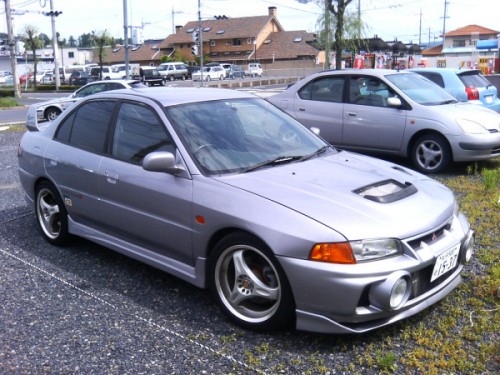
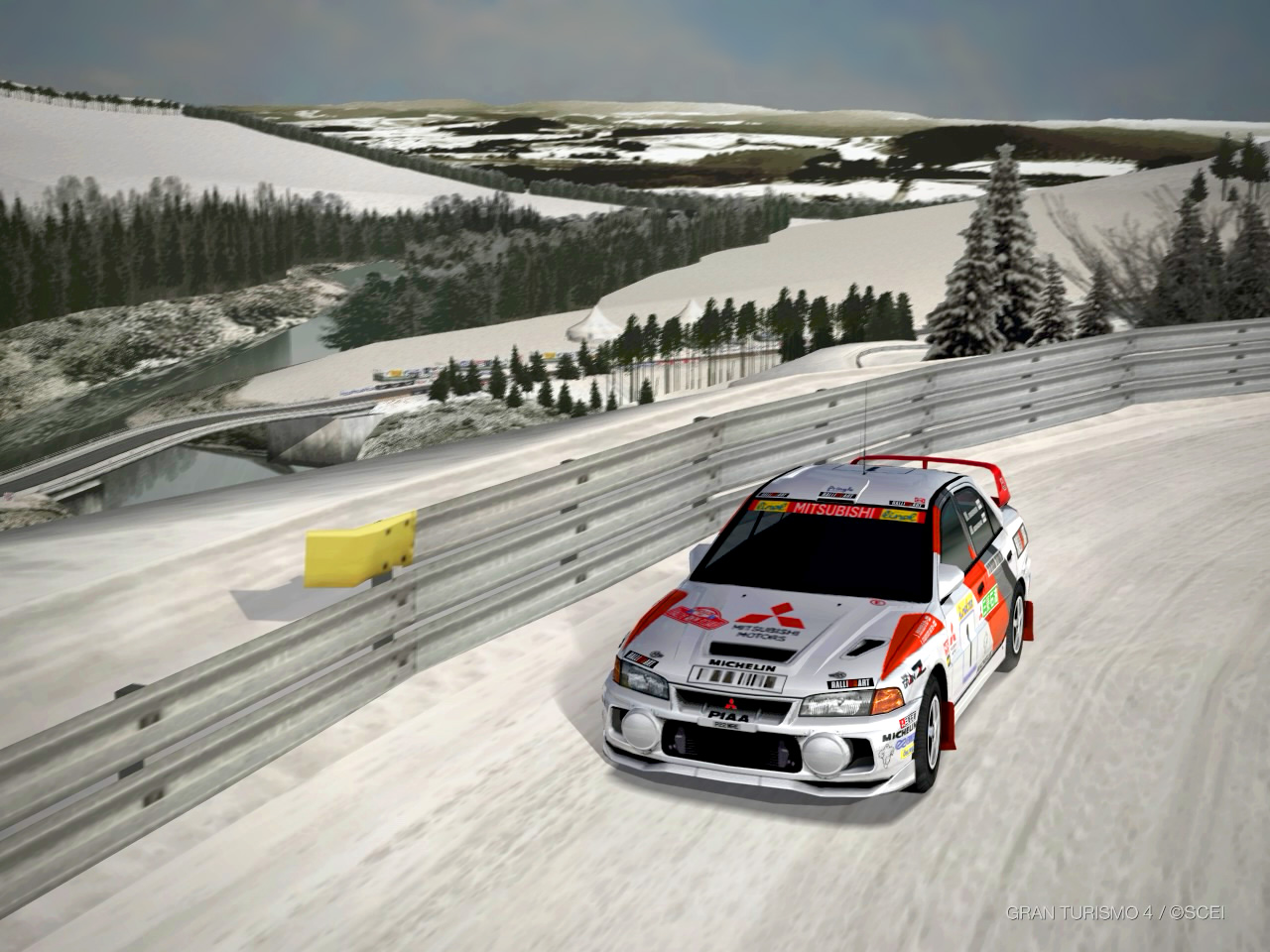
The Evolution IV can be distinguished by its two large fog lights in the front bumper (option on RS version), and the newly designed tail lights on the rear, which became a standard design to Evolution VI, which would become yet another trademark of the Evolution series.
This new generation was slightly heavier than previous Evos—the GSR in particular due to the added technology systems—but to counter this the car produced even more power—the weight of the RS being 1260 kg (2778 lb) and the GSR being 1345 kg (2965 lb).
The RS version was produced as a competition car with a limited-slip front differential and a friction type LSD at the rear. It also came with GLX seats and 16" (41 cm) steel wheels as these were items that would be replaced by anyone entering the car into competition events.
The RS also had wind up windows, no air conditioning, and a few extra brace bars to strengthen the chassis, one behind the front grill and the other across the boot floor. The RS also had a factory option of thinner body panels and thinner glass.
The GSR and the RS shared a new twin scroll turbocharger which helped to increase power to 280 PS (276 hp/206 kW) at 6,500 rpm and 260 ft·lbf (352 N·m) of torque at 3,000 rpm. Mitsubishi's new Active Yaw Control appeared as a factory option on the GSR model, which used steering, throttle input sensors and g sensors to computer-hydraulically controlled torque split individually to the rear wheels and as a result the 10,000 Evolution IVs produced all sold quickly.
The Evolution IV can be distinguished by its two large fog lights in the front bumper (option on RS version), and the newly designed tail lights on the rear, which became a standard design to Evolution VI, which would become yet another trademark of the Evolution series.
This new generation was slightly heavier than previous Evos—the GSR in particular due to the added technology systems—but to counter this the car produced even more power—the weight of the RS being 1260 kg (2778 lb) and the GSR being 1345 kg (2965 lb).
Bugatti EB110 Photo Gallery
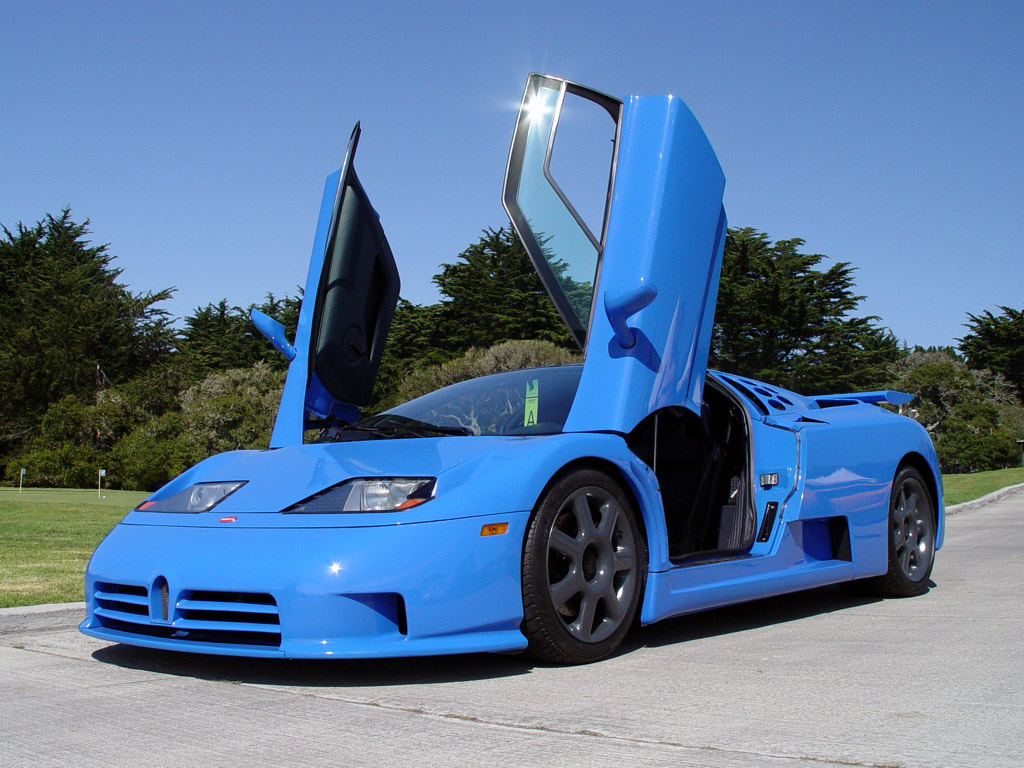
The Bugatti EB110 is a sports car manufactured by Bugatti Automobili SpA in between the years 1991-1995.
The price of the Bugatti EB110 cost over $350,000 US, it was also driven by Phil Hill, a United States automobile racer. The Bugatti EB110 was also purchased by the seven time world champion Michael Schumacher, which he later sold the car in the year 2003.
The Bugatti EB110 featured six speed automatic transmission and the gear shifts can be performed easily at higher stress. The body of the car is made of aluminum and carbon fibre and it featured a double wish suspension, glass engine with speed sensitive electronic rear.
In the year 1991, the Bugatti EB110 featured a 3.5 L quad-turbo V12 engine with 60 valves. The capacity of the engine is 3499 cc and it delivered an output power of 524 bhp at 8000 rpm and it reached the speed of 62 mph in 4.5 seconds and the top speed is about 213 mph.
In the year 1992, the Bugatti EB110 “SuperSport” version was launched. The engine delivered an output power of 592 bhp at 8000 rpm and it reached the speed of 62 mph in 3.2 seconds and the top speed is about 216 mph.
Specifications
Vehicle Type: - 2-door coupe
Configuration: - Mid Engine
Engine: - 3.5 L quad-turbo V12
Capacity: - 3499 cc
Transmission: - 6-Speed Manual
Wheelbase: - 100.5 inches
Length: - 173.4 inches
Weight: - 3560 lbs
B Engineering Edonis
The B Engineering Edonis was built based on the model of Bugatti EB110 SuperSport. It featured a powerful 3.5 L quad-turbo V12 engine with four IHI turbochargers and an engine capacity of 3760 cc. The engine delivered an output power of 670 bhp at 8000 rpm and 542 lb-ft torque. It reached the speed of 62 mph in 3.9 seconds and the top speed is about 227 mph.
Dauer EB110
The Dauer EB110 was manufactured in two different forms which are the EB110 and Super Sport. Both these cars featured a powerful 3.5 L quad-cam V12 engine with four IHI turbochargers. The engine of the Dauer EB110 delivered an output power of 560 bhp at 8000 rpm and the Super Sport delivered an output power of 650 bhp at 8200 rpm. Both these cars reached the speed of 60 mph in 3.3 seconds and the top speed is about 230 mph.This is a gathering of Bugattis that was in the Champs Elysées to celebrate the 100 years of the brand. There were a LOT of old models, but I didn’t much care for them… There were two Bugatti Veyrons: one black/black and one limited edition “Centenaire”. And a white and very EB110. Considering we could see them from outside but not get IN the stands, excuse the real sucky video… But I had to share ^^ – ALEX
The price of the Bugatti EB110 cost over $350,000 US, it was also driven by Phil Hill, a United States automobile racer. The Bugatti EB110 was also purchased by the seven time world champion Michael Schumacher, which he later sold the car in the year 2003.
The Bugatti EB110 featured six speed automatic transmission and the gear shifts can be performed easily at higher stress. The body of the car is made of aluminum and carbon fibre and it featured a double wish suspension, glass engine with speed sensitive electronic rear.
In the year 1991, the Bugatti EB110 featured a 3.5 L quad-turbo V12 engine with 60 valves. The capacity of the engine is 3499 cc and it delivered an output power of 524 bhp at 8000 rpm and it reached the speed of 62 mph in 4.5 seconds and the top speed is about 213 mph.
In the year 1992, the Bugatti EB110 “SuperSport” version was launched. The engine delivered an output power of 592 bhp at 8000 rpm and it reached the speed of 62 mph in 3.2 seconds and the top speed is about 216 mph.
Specifications
Vehicle Type: - 2-door coupe
Configuration: - Mid Engine
Engine: - 3.5 L quad-turbo V12
Capacity: - 3499 cc
Transmission: - 6-Speed Manual
Wheelbase: - 100.5 inches
Length: - 173.4 inches
Weight: - 3560 lbs
B Engineering Edonis
The B Engineering Edonis was built based on the model of Bugatti EB110 SuperSport. It featured a powerful 3.5 L quad-turbo V12 engine with four IHI turbochargers and an engine capacity of 3760 cc. The engine delivered an output power of 670 bhp at 8000 rpm and 542 lb-ft torque. It reached the speed of 62 mph in 3.9 seconds and the top speed is about 227 mph.
Dauer EB110
The Dauer EB110 was manufactured in two different forms which are the EB110 and Super Sport. Both these cars featured a powerful 3.5 L quad-cam V12 engine with four IHI turbochargers. The engine of the Dauer EB110 delivered an output power of 560 bhp at 8000 rpm and the Super Sport delivered an output power of 650 bhp at 8200 rpm. Both these cars reached the speed of 60 mph in 3.3 seconds and the top speed is about 230 mph.This is a gathering of Bugattis that was in the Champs Elysées to celebrate the 100 years of the brand. There were a LOT of old models, but I didn’t much care for them… There were two Bugatti Veyrons: one black/black and one limited edition “Centenaire”. And a white and very EB110. Considering we could see them from outside but not get IN the stands, excuse the real sucky video… But I had to share ^^ – ALEX
Audi r8 wallpapers
Audi announced the launch of Audi R8 Spyder featuring the new 4.2L V8 FSI engine with six-speed manual (£95,545) or six-speed R tronic automated manual transmission (£100,855). The latest generation V8 gives 430PS at 7,900rpm, 430Nm from 4,500 to 6,000rpm, 0-62mph in 4.8 seconds, top speed 186mph, combined mpg 20.9 (R tronic). Audi is accepting orders for the new R8 Spyder with deliveries beginning in January 2011.
StandardWidescreenStandard Wallpapers
The standard wallpapers could be used for following resolutions:
1600×1200 | 1400×1050 | 1280×1024 | 1280×960 | 1152×864 | 1024×768 | 800×600 | 320×240 | 160×120Widescreen Wallpapers
The widescreen wallpapers could be used for following resolutions:
StandardWidescreenStandard Wallpapers
The standard wallpapers could be used for following resolutions:
1600×1200 | 1400×1050 | 1280×1024 | 1280×960 | 1152×864 | 1024×768 | 800×600 | 320×240 | 160×120Widescreen Wallpapers
The widescreen wallpapers could be used for following resolutions:
Subscribe to:
Comments (Atom)